
A wave of retirements
Boeing notes that large groups of aviation workers will retire over the next decade, especially among pilots in North America and Europe. That replacement demand remains high and spills over into a global talent market.
More than a job
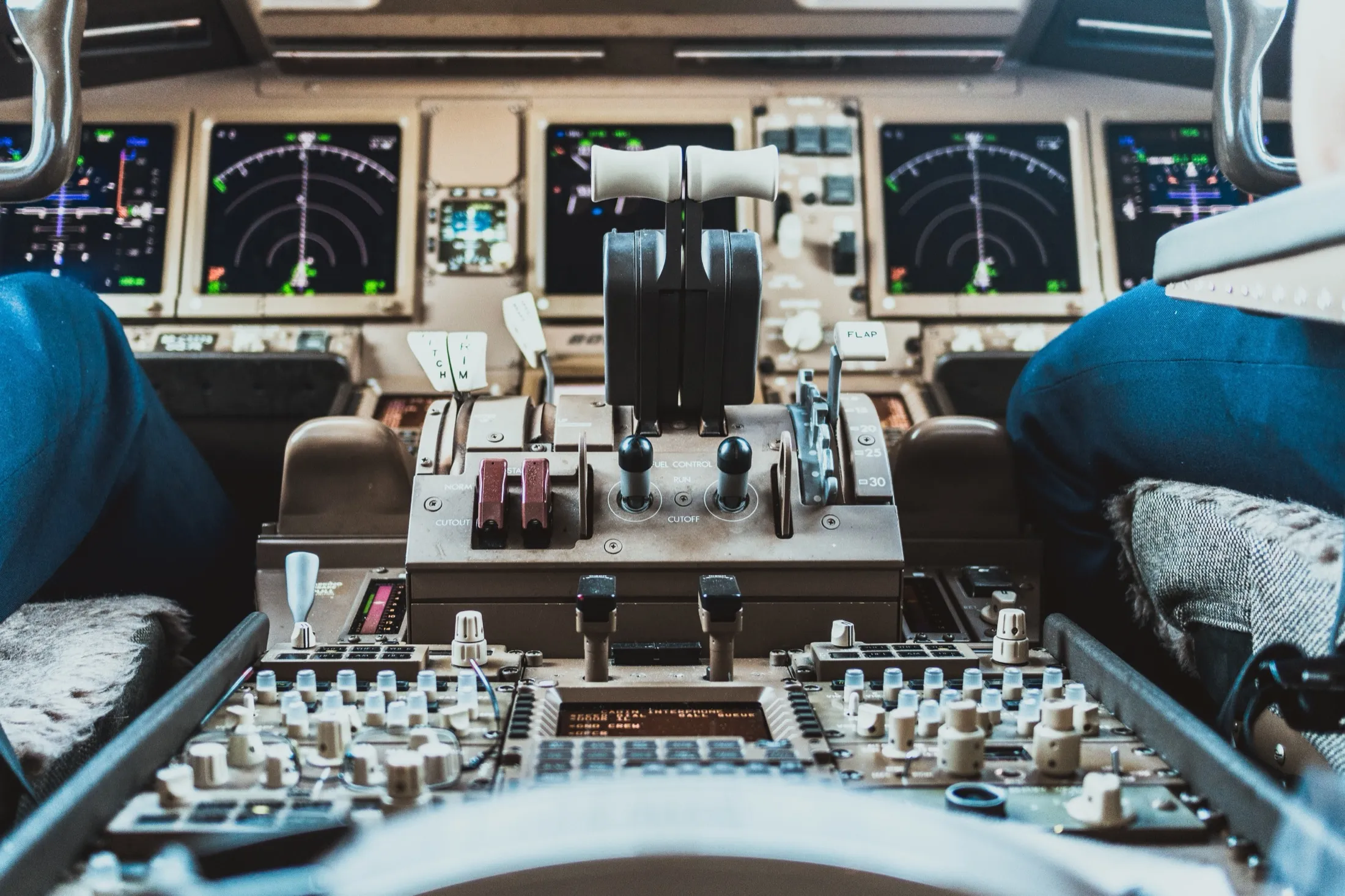
At night, the cockpit lights up: displays, radar, silence and the sleeping planet far below. This is what the career feels like.
Your workplace is thousands of meters up, with the best view on the planet.
Displays, automation and systems that evolve every year. You never stop learning.
You carry the responsibility for hundreds of people. Your judgment and your preparation matter.
Licenses follow ICAO standards and English is the common language of aviation worldwide.
The career
The industry data is clear: over the next 20 years, hundreds of thousands of new pilots will be needed. This is your chance to be one of them.
674,000
new pilots worldwide
2026–2045
38,000
new pilots in Latin America
2026–2045
2,425,000
aviation professionals in total
pilots, technicians and cabin crew
Source: Boeing Pilot & Technician Outlook 2026. The previous edition (2025–2044) projected 660,000 pilots worldwide and 37,000 in Latin America: the forecast rose in a single year.
Where they are needed
Boeing projects 674,000 new pilots through 2045, and every region needs them. With an ICAO-standard license and English as the common language, you can aim to fly anywhere in the world. That is the great opportunity.
Bolivian pilots already fly in Panama, the Middle East and Asia: see how much they earn. Each country validates foreign licenses under its own rules.
New pilots needed · 2026–2045
By region, according to Boeing Pilot & Technician Outlook 2026
Source: Boeing Pilot & Technician Outlook 2026. Worldwide total: 674,000 new pilots.
Why there is a pilot shortage
Boeing notes that large groups of aviation workers will retire over the next decade, especially among pilots in North America and Europe. That replacement demand remains high and spills over into a global talent market.
For Latin America alone, 2,405 new aircraft are projected through 2045, with air traffic growing 4.1% a year. Every aircraft needs more than one crew.
You cannot improvise a pilot: it takes months of instruction, flight hours and licenses. That is why the shortage cannot be solved overnight, and why starting today is an advantage.
Let’s be transparent
Boeing itself notes in its 2026 report that geopolitical and weather events this year led some airlines to adjust their pilot hiring plans, although it estimates the effect is temporary within the 20-year horizon. Aviation is cyclical and no school can guarantee a job. What a school can do is train you with rigor and safety, so you are ready when opportunities open up.
How to get there
Takeoff
≈ 7 monthsUSD 1,000
You learn the fundamentals, log your first flight hours and earn your license.
Climb
≈ 1 yearUSD 1,500
You refine your technique, fly by instruments and earn the license that lets you fly for pay.
Cruise
From day 1
With your license and a good level of aviation English, you are ready to apply to airlines and professional aviation.
Yes. Airline Pilot Academy is a Civil Aviation Training Center (CIAC) Type 3 (CCIAC-141-05-027), based in Cochabamba and operating since 2012.
The Private Pilot course takes about 7 months and the Commercial IFR Pilot course about 1 year. They are consecutive stages: you start with your private license and move on to the commercial one, which is the one that allows you to fly for pay.
Projected demand is high: Boeing estimates 674,000 new pilots worldwide between 2026–2045, 38,000 of them in Latin America. No school can guarantee a job, but the right training puts you in one of the professions with the greatest need for talent.
Age, medical certificate and documentation requirements are set by the Bolivian Aeronautical Regulations (RAB). Message us on WhatsApp and we will guide you step by step according to your situation.
English is the language of aviation, and ICAO requires pilots to demonstrate a minimum level of language proficiency to operate internationally. A good level of English will open many more doors in the profession.
Private Pilot: USD 1,000. Commercial Pilot: USD 1,500. FOI Instructional Techniques (40 hours): USD 145. FOI Recurrent (20 hours): USD 80. For the Basic SMS Course, contact us. Write to us and we will explain what each program includes and the payment options.
Safety is our priority. We apply a Safety Management System (SMS) and encourage a hazard-reporting culture: anyone can report a risk, voluntarily and anonymously.
Yes. At APA you can continue your training through the conversion of your pilot course. Write to us with your situation, we review what you have already completed and tell you how to continue.
Yes. Practical instruction takes place in Cochabamba; write to us and we will advise you on how to organize your schedule and your stay.
Sources: Boeing Pilot & Technician Outlook 2026–2045·Boeing Pilot & Technician Outlook 2025–2044.
Take the first step
Tell us your goals and we will explain how to get there: courses, requirements, timing and cost. No commitment.