
On September 6, 2026, a cargo Boeing 767 overran the end of the runway while landing at Miami International Airport. Five people on the ground lost their lives and three others were seriously injured. Both pilots survived.
This article does not seek to speculate or assign blame. It gathers what the investigating authority has made public, with links to each source, and offers some reflections for those of us training in aviation. Our condolences to the families and loved ones of the victims.
First: the investigation is still open
The investigation is led by the US National Transportation Safety Board (NTSB), under case DCA26MA352. As of the date of this article:
- The NTSB published a preliminary report on October 1, 2026, which it itself describes as “preliminary and subject to change”.
- It has not determined the probable cause. A final report usually takes a year or more.
- Everything below comes from official NTSB documents. If you find claims about “the cause” on social media, remember that there is still no official conclusion.
What happened, according to the NTSB
| Item | Official information |
|---|---|
| Date and time | September 6, 2026, 13:53 Miami local time (EDT) |
| Flight | 21 Air 7598, a domestic cargo flight operated for Amazon, from San Juan (Puerto Rico) to Miami |
| Aircraft | Boeing 767-33A, converted to a freighter in 2016 |
| Event | Overran the end of runway 30 after landing and hit two vehicles on the ground |
| Injuries | 5 killed and 3 seriously injured on the ground; 2 minor injuries among the crew |
| Conditions | Daytime, instrument flight; thunderstorms at the airport |
According to the report, the aircraft left the runway, knocked down the localizer and the approach lights, went through the airport perimeter fence, struck a pickup truck traveling on a perimeter road and a vehicle on NW 67th Avenue, and came to a stop about 1,200 feet (≈ 370 m) from the end of the pavement. There was a post-impact fire on the right wing. Both pilots evacuated the aircraft and airport firefighters responded immediately.
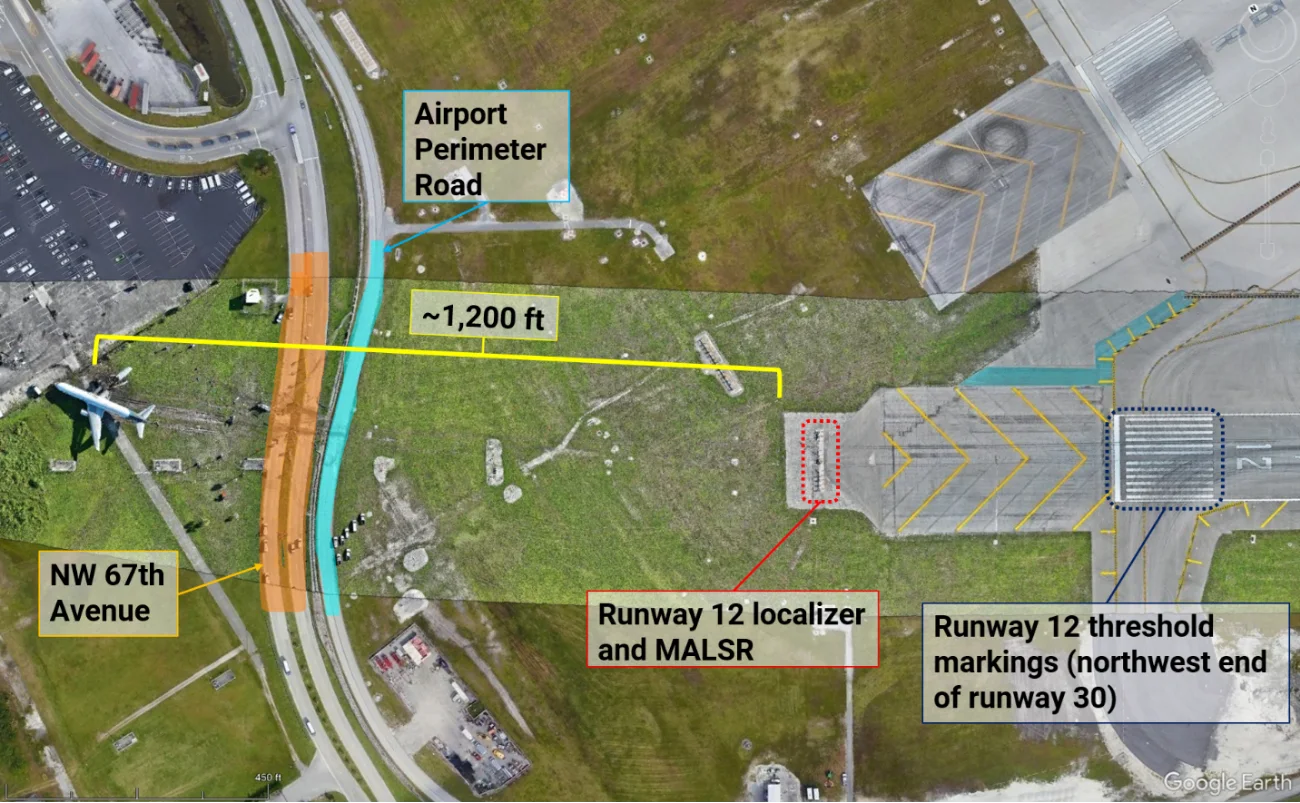
Source: NTSB, preliminary report DCA26MA352, pages 1–3 and 10–11.
The approach and landing, in data
These figures come from the flight data recorder (FDR) and the cockpit voice recorder (CVR), and are preliminary:
| Moment | Data |
|---|---|
| Runway 30 threshold crossing | ≈ 105 ft above ground level, ground speed of 177 kt |
| Touchdown | ≈ 3,750 ft (≈ 1,140 m) past the threshold, at 160 kt |
| Length of runway 12/30 | 9,360 ft (≈ 2,850 m), including a displaced threshold |
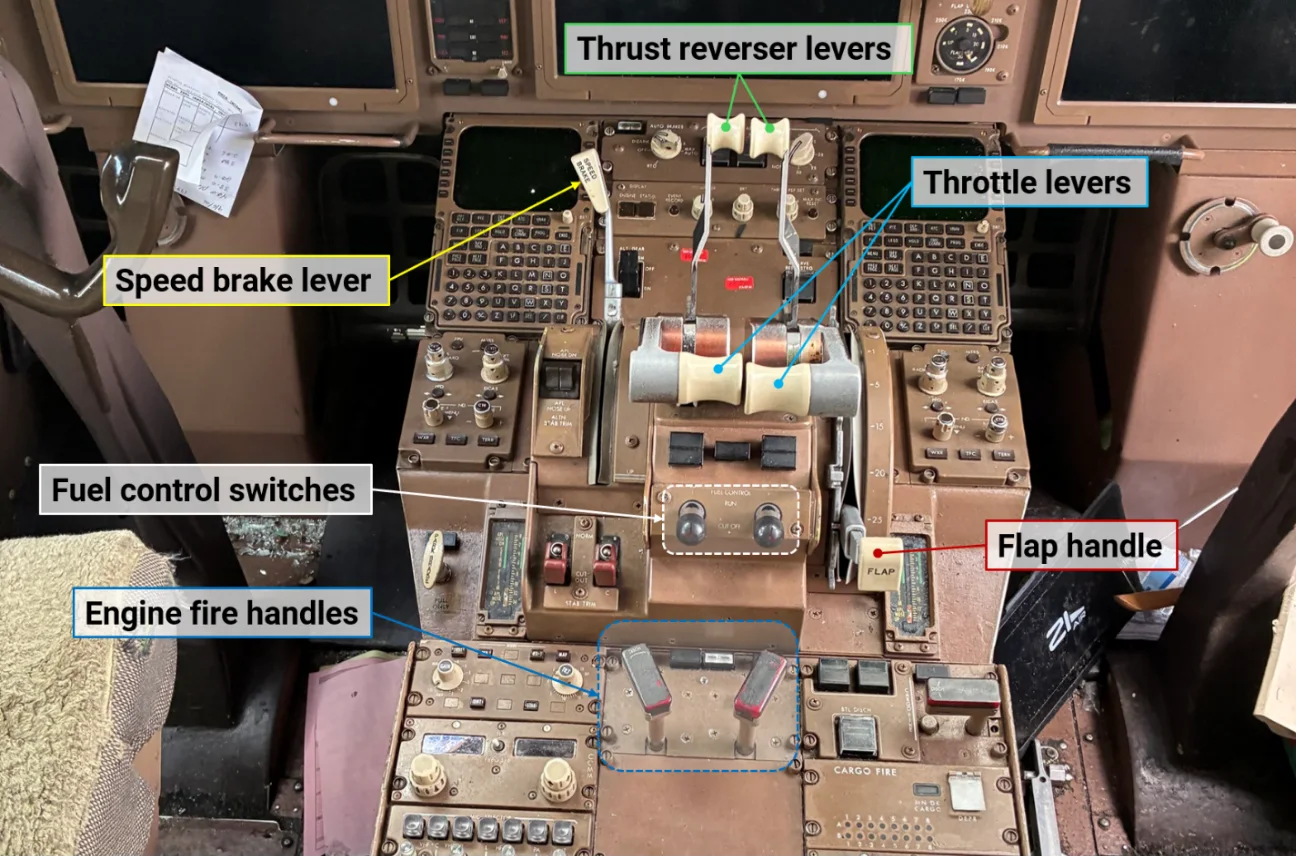
| Speed brakes and reverse | The speed brakes remained retracted and the thrust reversers did not deploy |
| Wheel brakes | Applied at 146 kt, released about 8 seconds later and reapplied when ≈ 415 ft of runway remained |
| Runway exit | At 113 kt |
On the cockpit recorder, the NTSB summarizes that about 1 minute 42 seconds before the end of the recording one pilot warned that they were going too fast, and made further comments about the excess speed until the end. The NTSB notes that there was no consistent verbal response to those comments. The aircraft’s automated alerts (“sink rate”, “too low terrain”) sounded during the approach, and about 15 seconds before the end of the recording a go-around was called for.
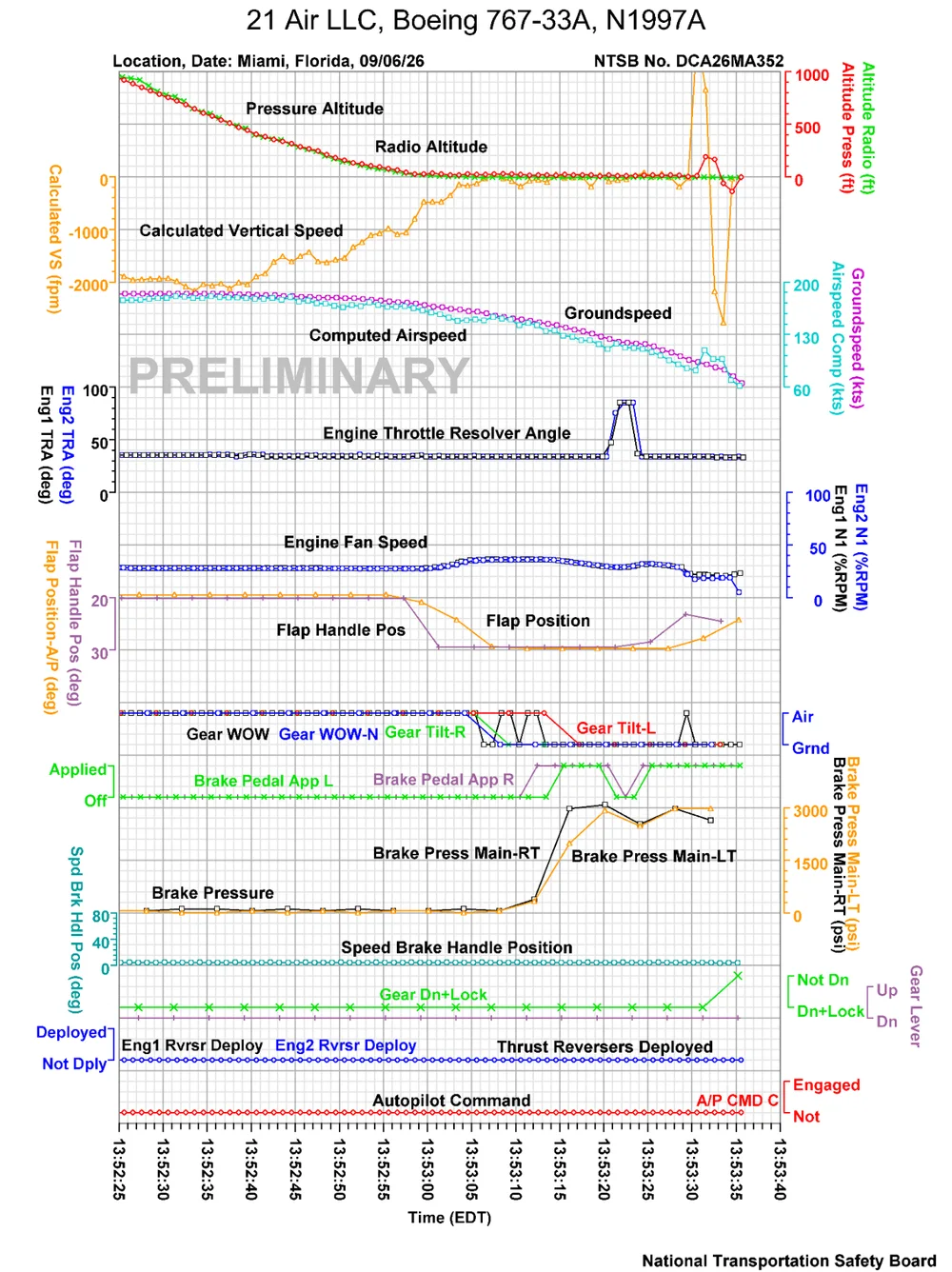
Sources: preliminary report, pages 2 and 6–7, and the NTSB update of September 9, 2026.
Weather and air traffic control
- At 13:53 the airport weather report indicated wind from 190° at 17 kt gusting to 26 kt, with thunderstorms in the area. The runway in use was 30.
- The NTSB points out that the controller cleared the landing without reporting the wind, and that the FAA’s rule for controllers (order JO 7110.65BB) requires reporting wind direction and speed when there is a tailwind component. About 4 minutes earlier, the controller had given the wind to another flight, but flight 7598 was not on that frequency.
- There was no EMAS at the end of runway 30. EMAS is a bed of material that stops aircraft that overrun the runway; the FAA regulates its design in advisory circular AC 150/5220-22B.
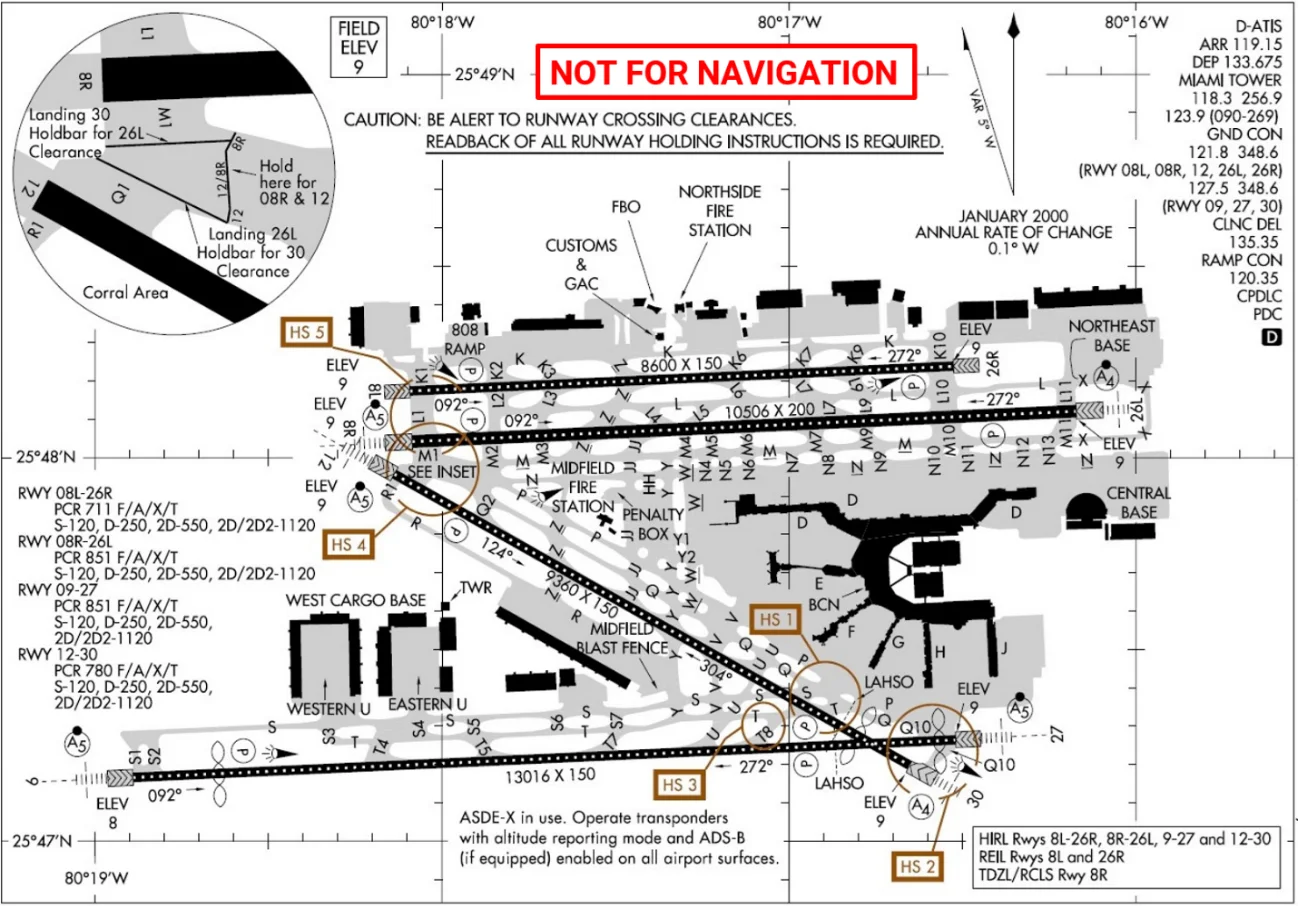
Source: preliminary report, pages 4–6.
What we still do not know
The NTSB still has to answer important questions. Among them: why the thrust reversers and speed brakes did not deploy, what factors influenced speed and touchdown, what role the weather and wind information played, and which airport defenses worked or were missing. The aircraft performance study and the human factors, operations and air traffic control groups are still working. Until the NTSB concludes, any explanation is only a hypothesis.
What we can learn
The following reflections are not conclusions about the cause of this accident. They are principles the industry has learned over decades from many accidents and that this case reminds us of. Each includes references to go deeper.
1. A go-around is always an option
An approach must be stabilized (speed, configuration, path) before an operator-defined height; if it is not, the right decision is to go around, and the sooner the better. Flight Safety Foundation guidance recommends stabilizing the approach no later than 1,000 ft above the aerodrome in instrument conditions and 500 ft in visual conditions, and going around if it ceases to be stabilized below that height. Even so, according to SKYbrary, multiple data sources indicate that more than 9 out of 10 unstabilized approaches continue to landing: this is the so-called continuation bias. A go-around decided after touching the runway is much harder than one decided with altitude to spare.
To go deeper: Stabilised Approach (SKYbrary) · FSF ALAR Briefing Note 7.1: Stabilized Approach (PDF) · Go-Around Decision Making (SKYbrary).
2. The monitoring pilot must speak up, and the flying pilot must listen
Crew resource management (CRM) teaches that the monitoring pilot has an obligation to say what they see, clearly and concretely, and that the flying pilot must acknowledge it and act. A warning that gets no response has no effect. Practice direct phrases (“speed high, go around”) and cultivate the habit of always responding.
To go deeper: Crew Resource Management (SKYbrary) · FAA AC 120-51E: CRM training.
3. Aircraft alerts call for immediate action
Alerts such as “sink rate” or “too low terrain” exist to interrupt a pattern. Each operator’s standard operating procedures define how to respond; know them by heart.
4. Know the wind and the distance you need
Wind with a tailwind component increases ground speed and landing distance. According to the FAA advisory circular AC 91-79A, “Mitigating the Risks of a Runway Overrun Upon Landing”, a tailwind increases landing distance by 21% for the first 10 kt. Before landing, check the METAR or ATIS, calculate the wind component and the distance needed, and if the controller does not give you the wind, ask for it. To practice reading the weather report, read how to read a METAR.
To go deeper: FAA AC 91-79A (PDF) · Tailwind Operations (SKYbrary) · FSF ALAR Briefing Note 8.3: Landing Distances (PDF).
5. Use all braking means, and on time
Speed brakes, thrust reversers and wheel brakes combine to stop the aircraft. Knowing how much runway remains and applying each means without delay is a discipline that is trained.
6. Defenses work in layers
An accident rarely has a single cause: it usually happens when several defenses fail or are missing at once: the controller’s information, the cockpit dialogue, the aircraft’s alerts, the airport’s design and the runway safety areas. That is why safety management systems (SMS) seek to identify hazards before they line up. More in what an SMS is.
To go deeper: Runway Excursions: causes and defenses (SKYbrary) · FAA AC 150/5220-22B: EMAS.
7. Safety is everyone’s business, and it also protects those on the ground
This time the victims were people working or passing through the airport’s surroundings, not on board. Operational safety includes ramp, maintenance, cleaning and aerodrome service staff, and anyone can contribute by reporting a hazard.
8. Humility in the face of the facts
It is easy, with hindsight, to say “I would have done something else”. Investigators work to understand and prevent, not to blame. Whoever studies aviation honors the victims by learning with rigor and respect, and by not repeating rumors.
For your training
- Ask your instructor to review the stabilized approach criteria and to practice go-arounds at different phases.
- Practice cockpit dialogue in the simulator, with standardized callouts and responses.
- Always calculate wind component and landing distance before each approach.
- Review the preliminary and final reports of investigations: they are free and valuable study material.
Sources and references
Official sources for the case (consulted on November 21, 2026):
- Preliminary report DCA26MA352, NTSB (PDF, 12 pages)
- Investigation page DCA26MA352, NTSB
- Investigation update of September 9, 2026, NTSB
Educational references:
- Stabilised Approach, SKYbrary
- FSF ALAR Briefing Note 7.1: Stabilized Approach (PDF)
- Go-Around Decision Making, SKYbrary
- Crew Resource Management, SKYbrary
- FAA AC 120-51E: Crew Resource Management Training
- FAA AC 91-79A: Mitigating the Risks of a Runway Overrun Upon Landing (PDF)
- Tailwind Operations, SKYbrary
- FSF ALAR Briefing Note 8.3: Landing Distances (PDF)
- Runway Excursion, SKYbrary
- FAA AC 150/5220-22B: Engineered Materials Arresting Systems (EMAS)
The latest NTSB update as of the date of this article is from October 1, 2026. We will update this text when the NTSB publishes new findings or its final report.
By Cap. Renan Montano · Published on November 21, 2026 · Airline Pilot Academy